


Investing in the Most Urgent Need in Modern Neuropsychiatry – Treatment of Alzheimer’s Disease
Overview
Cogniguard is, for the first time, offering real hope for an effective treatment of Alzheimer’s disease by targeting a well-established and safe neuromodulation method: vagus nerve stimulation.
Our therapy has been specifically designed for nighttime use, taking advantage of the critical role sleep plays in memory consolidation — a process profoundly disrupted already in the earliest stages of Alzheimer’s disease.
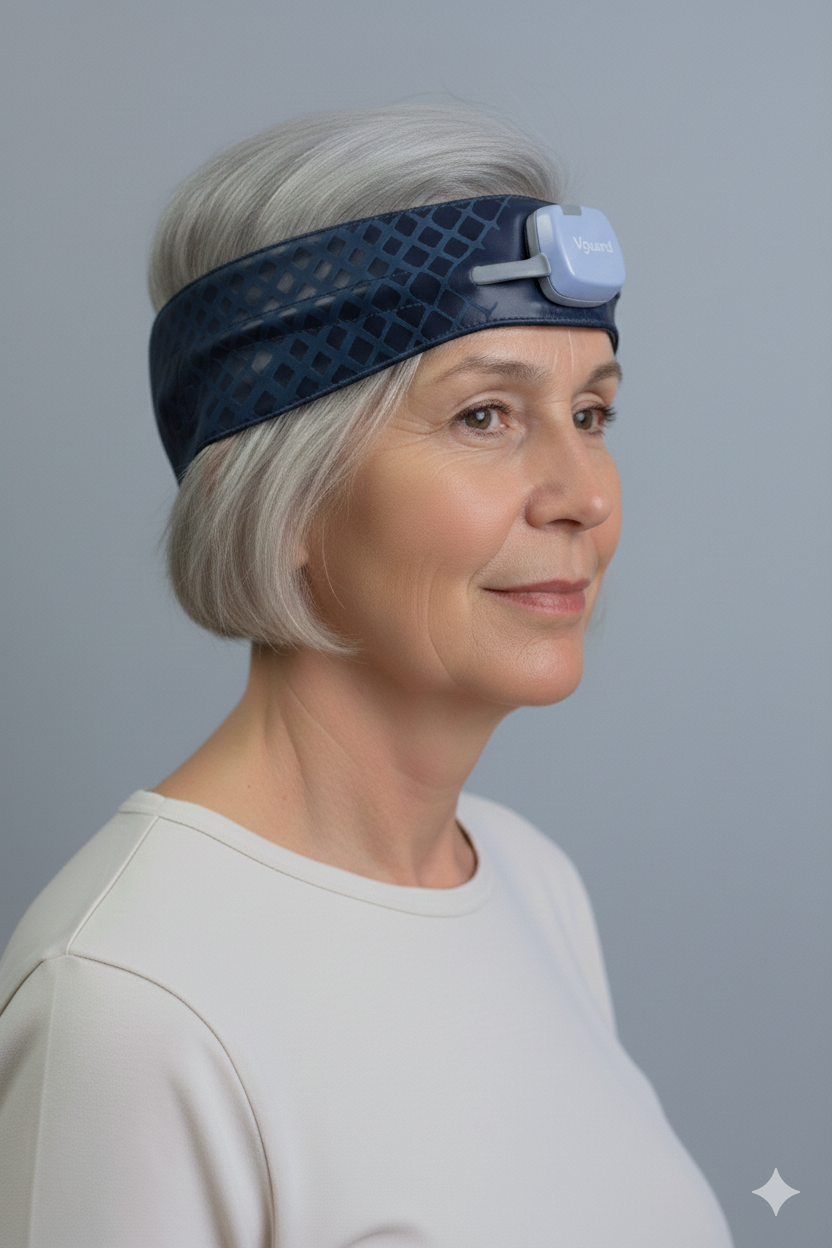
Unlike pharmaceutical options that provide only temporary symptomatic relief, Vguard aims to improve cognitive status by activating memory-related brain functions during sleep.
We are supported by European Union innovation funding and long-standing partnerships with
leading clinical research centers.
Cogniguard has implemented an ISO 13485–certified Quality Management System, underscoring our readiness for regulatory approvals and clinical scale-up. CE MDR Class IIa certification confirms Vguard’s regulatory readiness for European market entry and clinical commercialization.

Market Opportunity
- Over 55 million people worldwide live with dementia; 70% have Alzheimer’s
- 7 million Americans affected today; numbers expected to double by 2050
- Annual global economic burden: $1.3 trillion
- US. Medicare & Medicaid costs: $230B today, projected to reach $650B by 2050
Current Alzheimer’s drugs:
- Offer only temporary symptomatic relief
- Have severe adverse effects (38–48%)
- Newly introduced therapy cost is between $20K–$30K/year
How Vguard Differs
Vguard, unlike pharmacological treatments, offers the first method targeting the core symptoms of Alzheimer’s disease — memory loss and cognitive decline — through non-invasive vagus nerve stimulation.
The device is designed for cognitively impaired patients and features an easy-to-use neural stimulator controlled by a mobile app. The entire therapy is continuously monitored by a sophisticated cloud-based system that collects real-time stimulation parameters and allows caregivers to effortlessly track treatment compliance.
Competitive Landscape
| Therapy Type | Route | Setting | Adverse Events | Cognitive Benefit |
|---|---|---|---|---|
| Biologic Drugs | IV | Clinic | 38–48% SAE | ~1.4 ADAS-Cog points @ 18 mo |
| TMS | Non-invasive | Clinic | 18% SAE | Non-significant |
| AV Therapy | Non-invasive | Home | 13–15% AE | Non-significant |
| Vguard | Non-invasive (night use) | Home | 6% minor AE | 6-point gain @ 12 weeks |
Scientific Validation & Clinical Progress
- 7 granted patents (4 US, 2 China, 1 EU) protecting core IP
- First neuroscientific demonstration of hippocampal theta II activation via vagus nerve stimulation in an animal model
- Stimulation patterns developed through proprietary preclinical studies
- First-in-human clinical validation shows meaningful improvements in memory and other cognitive functions, significantly outperforming existing drugs
- Well tolerated with only minor side effects
- Full publication record available under NDA
Grants & Strategic Partnerships
- Supported by EU innovation grants for R&D and clinical programs
- Collaborations with leading universities and hospitals
- EU medical market approval — VGuard became the first globally CE-MDR-cleared method (2025) for the treatment of Alzheimer’s disease and Mild Cognitive Impairment
- Active communication with the U.S. FDA, with initial certification guidance received
Milestones & Roadmap
2016
Awarded EU R&D Grant
Secured European funding to pioneer breakthrough neurotechnology research.
2017
Launch of Preclinical Animal Trials
Initiated rigorous safety and efficacy testing to validate therapeutic potential.
2018
Discovery of Theta Rhythm via Vagal Nerve Stimulation
Identified a groundbreaking neural mechanism with implications for cognitive regeneration.
2019
First Peer‑Reviewed Scientific Publication (1 of 7)
Shared pioneering results with the global scientific community, reinforcing academic credibility.
fMRI Validation Trials
Conducted advanced imaging studies to demonstrate measurable brain activity changes.
2020
First‑in‑Human Clinical Trial (60 Patients, Poland)
Began clinical evaluation of safety and efficacy in Alzheimer’s patients.
2023
Clinical Trial at Israeli Alzheimer’s Center
Expanded international research footprint with a leading medical institution.
CE Certification Process with TÜV Rheinland & V2 Development
Entered formal European regulatory pathways while preparing next‑generation technology.
2025
CE MDR Certification Achieved
Officially certified under the EU Medical Device Regulation, ensuring compliance and trust.
Start of V3 Mass Production
Transitioned from prototype to scalable manufacturing for broader accessibility.
2026
Multicenter Clinical Trial Across Europe
Strengthening evidence base with large‑scale, multi‑site patient studies.
2027
European Market Launch
Introducing Cogniguard technology to healthcare providers across the EU.
U.S. Pivotal Trial
Initiating FDA‑aligned pivotal study to prepare for U.S. market entry.
2028
U.S. Market Launch
Bringing Cogniguard innovation to American patients and clinicians.
Publications & Research
For a full list of our peer-reviewed publications, including hippocampal
VNS stimulation feferences available in the Clinical & Scientific section or under NDA.

Media & Press Releases
Stay connected via:
- Our official LinkedIn page for thought leadership and updates
Let’s Talk – Under NDA
We welcome contact from qualified investors. Detailed clinical, regulatory,
and financial data is available following the signing of a Non-Disclosure Agreement.
Contact: info@cogniguard.com
This section presents publicly available information only.