


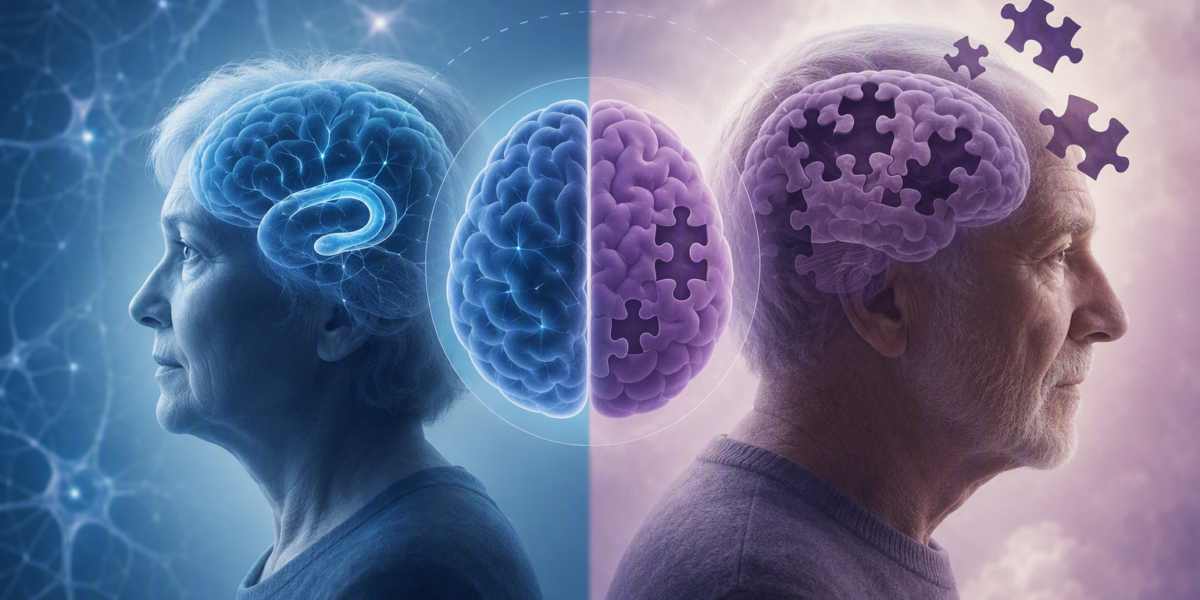
Dementia and Alzheimer’s disease are terms that are often used interchangeably. However, they do not mean the same thing. Dementia is a broad term describing a group of symptoms that affect memory, thinking, communication, behavior, and the ability to perform everyday activities. Alzheimer’s disease, on the other hand, is a specific brain disorder and the most common cause of dementia.. [mayoclinic.org], [alz.org],
Understanding this distinction is important for patients, caregivers, and families. It helps people recognize symptoms earlier, seek appropriate medical advice, and better understand what may be causing cognitive decline.
In this article we explain what is the difference between dementia and Alzheimers and when to consult a specialist.
What Is Dementia?
Dementia is not a single disease. It is an umbrella term used to describe a collection of symptoms that occur when diseases or injuries affect the brain. Dementia can impact memory, thinking, communication, behavior, mood, and the ability to carry out everyday tasks [who.int]
Simply put, dementia means that changes in brain function begin to interfere with everyday life. It is not about occasionally forgetting a name, misplacing keys, or experiencing a moment of distraction. Dementia is diagnosed when cognitive problems become persistent, progressive, and begin to affect a person’s independence.
Typical symptoms of dementia may include:
- Memory impairment
- Difficulty concentrating
- Problems with planning and decision-making
- Disorientation in time or place
- Communication difficulties
- Changes in behavior, mood, or personality
- Increasing difficulty performing everyday activities
Importantly, dementia is not a normal part of aging. Although it occurs more frequently in people over the age of 65, it does not mean that every older adult should experience cognitive decline. The World Health Organization emphasizes that dementia is more common in later life, but it is not an inevitable consequence of aging.
What Is Alzheimer’s Disease?
Alzheimer’s disease is a specific, progressive neurodegenerative disorder of the brain. This means that brain cells gradually become damaged over time, leading to a decline in cognitive function. Alzheimer’s disease causes symptoms of dementia that worsen as the condition progresses.
Alzheimer’s disease typically first affects areas of the brain involved in learning and memory. As a result, one of the most common early symptoms is difficulty remembering newly learned information — for example, repeating the same questions, forgetting recent conversations, or struggling to recall recent events.
As the disease progresses, additional challenges may appear, including disorientation, language difficulties, behavioral changes, impaired judgment, and growing dependence on assistance from others. The Alzheimer’s Association notes that advanced stages of the disease may lead to significant confusion, behavioral changes, and eventually difficulty speaking, swallowing, and walking.
Dementia vs Alzheimer’s Disease — The Most Important Difference
The simplest explanation is:
Dementia is a syndrome of symptoms. Alzheimer’s disease is one of the diseases that can cause those symptoms.
A useful comparison is a headache. A headache is a symptom, but it can be caused by fatigue, migraine, dehydration, infection, or many other conditions. Similarly, dementia describes the symptoms but does not identify the underlying cause.
Alzheimer’s disease is the most common cause of dementia. According to the World Health Organization, Alzheimer’s disease may account for approximately 60–70% of dementia cases worldwide. The Alzheimer’s Association estimates that Alzheimer’s is responsible for 60–80% of dementia cases. Although percentages vary between sources and methodologies, both organizations identify Alzheimer’s disease as the leading cause of dementia.
However, it is not the only one. Dementia can also result from vascular dementia, Lewy body dementia, frontotemporal dementia, Parkinson’s disease dementia, or mixed dementia.
Is Every Dementia Alzheimer’s Disease?
No.
Every case of Alzheimer’s disease can lead to dementia, but not every case of dementia is caused by Alzheimer’s disease.
This distinction is important because different types of dementia may have different patterns of symptoms and progression. In Alzheimer’s disease, memory difficulties often appear early. In other forms of dementia, the first symptoms may involve behavior, language, attention, executive function, or movement.
For this reason, observing symptoms alone is not always enough to determine the cause. Proper diagnosis requires evaluation by a healthcare professional such as a neurologist, geriatrician, psychiatrist, or neuropsychologist.
Normal Aging, MCI, Dementia, and Alzheimer’s Disease — What’s the Difference?
A common question is:
“Is this Alzheimer’s disease or simply aging?”
Normal Aging
As people age, it is normal to occasionally need more time to remember a name, find the right word, or concentrate on a task. These changes are usually not considered a disease if they do not interfere with daily functioning and do not progressively worsen.
Mild Cognitive Impairment (MCI)
Mild Cognitive Impairment (MCI) is considered an intermediate stage between normal aging and dementia. A person with MCI may notice memory or thinking difficulties but generally remains independent in everyday life. [alz.org]
Dementia
Dementia refers to cognitive impairment severe enough to affect daily life — such as managing finances, taking medications correctly, navigating familiar environments, communicating effectively, or maintaining personal safety.
Alzheimer’s Disease
Alzheimer’s disease is a specific brain disorder that may begin with subtle memory problems and gradually progress to increasingly severe symptoms of dementia. Its course is typically progressive and worsening over time.
Which Symptoms Should Be Concerning?
Occasional forgetfulness does not necessarily indicate disease.
However, it is worth paying attention when symptoms are repetitive, increasing in frequency, or beginning to affect daily functioning.
Potential warning signs include:
- Frequently forgetting recent conversations or events
- Repeating the same questions
- Difficulty learning new information
- Getting lost in familiar places
- Problems completing familiar tasks
- Increasing disorganization
- Difficulty planning or making decisions
- Changes in mood, behavior, or personality
- Withdrawal from social activities
- Difficulty finding words or following conversation
The Mayo Clinic identifies memory decline, changes in thinking and reasoning, reduced attention, language difficulties, and behavioral changes as common symptoms of dementia. The World Health Organization similarly notes that dementia can affect memory, thinking, communication, mood, and behavior.
When Should You See a Doctor?
It is advisable to seek professional evaluation when memory or thinking problems:
- Occur repeatedly
- Gradually worsen
- Do not improve with rest
- Interfere with daily activities
- Are noticed by family members or friends
- Cause concern for the individual or caregiver
An early consultation does not automatically mean a diagnosis of Alzheimer’s disease. Instead, it can help identify potential causes of cognitive changes, rule out treatable conditions, and determine whether further assessment is needed.
It is also important to remember that memory problems can result from many causes other than neurodegenerative disease. Sleep disorders, depression, stress, metabolic conditions, vascular diseases, medication effects, and nutritional deficiencies can all contribute to cognitive symptoms. Proper evaluation helps distinguish between these possibilities.
Why Does Accurate Terminology Matter?
Distinguishing between dementia and Alzheimer’s disease helps avoid two common mistakes.
The first is dismissing symptoms as “just getting older.” This can delay assessment and support. Dementia is not an inevitable part of aging.
The second is assuming that every memory problem automatically means Alzheimer’s disease. While Alzheimer’s is the most common cause of dementia, it is not the only one.
Using the correct terminology helps people maintain a balanced perspective — taking symptoms seriously without unnecessary fear.
Dementia vs Alzheimer’s Disease — Comparison Table
| Question | Dementia | Alzheimer’s Disease |
|---|---|---|
| What is it? | A syndrome that affects memory, thinking, and daily functioning. | A specific progressive brain disease. |
| Is it a single disease? | No. It is a general term describing symptoms | Yes. It is one disease that can cause dementia. |
| Does it affect daily life? | Yes, when symptoms become severe enough to interfere with independence. | Yes, symptoms increasingly affect independence as the disease progresses. |
| Is it a normal part of aging? | No. | No. |
| How often does it cause dementia? | Dementia can result from many causes. | Alzheimer’s disease is the most common cause of dementia. |
Dementia is a general term and Alzheimers is a specific brain disease and a common cause of dementia.
What Can Families Do If They Notice Symptoms?
The most important approach is to remain calm, supportive, and non-judgmental.
A person experiencing memory difficulties may feel anxious, embarrassed, or frustrated. Instead of saying, “You keep forgetting everything,” it may be more helpful to say: “We’ve noticed a few situations that concerned us. Perhaps it would be worth talking to a doctor to understand what’s causing them.”
Helpful steps include:
- Writing down specific examples of concerning situations
- Monitoring whether symptoms repeat or worsen
- Talking openly without criticism or shame
- Scheduling a medical evaluation
- Preparing a list of medications and existing health conditions
- Observing sleep quality, mood, and daily functioning
The goal of assessment is not simply to assign a diagnosis. The goal is to understand what is happening and determine what support may be helpful.
Frequently Asked Questions
Are dementia and Alzheimer’s disease the same thing?
No. Dementia is a general term describing symptoms that affect memory, thinking, and daily functioning. Alzheimer’s disease is a specific brain disorder and the most common cause of dementia.
Does everyone with Alzheimer’s disease develop dementia?
Alzheimer’s disease causes symptoms of dementia that gradually worsen over time.
Is every dementia Alzheimer’s disease?
No. Dementia can result from many causes, including vascular dementia, Lewy body dementia, frontotemporal dementia, Parkinson’s disease dementia, and mixed dementia.
Does memory loss always mean dementia?
No. Cognitive changes become concerning when they are persistent, progressive, and begin to interfere with daily functioning.
Is dementia a normal part of aging?
No. Dementia becomes more common with age but is not an inevitable consequence of getting older.
When should someone seek professional help?
If problems with memory, concentration, communication, orientation, or daily functioning are recurring, worsening, or causing concern for the individual or family members, a medical evaluation is recommended.
Conclusion
Dementia and Alzheimer’s disease are closely related, but they are not the same thing.
Dementia is a syndrome that affects memory, thinking, behavior, and daily functioning. Alzheimer’s disease is a specific brain disorder and the most common cause of dementia.
Understanding this difference can help individuals and families recognize warning signs earlier, avoid common misconceptions, and take appropriate steps toward assessment and support. Occasional forgetfulness does not necessarily indicate disease. However, when memory or thinking problems become persistent, progressive, and begin affecting daily life, it is important to seek professional advice.
Medical Disclaimer
This article is intended for educational purposes only and does not replace consultation with a qualified healthcare professional. If you or a loved one experiences concerns related to memory, concentration, behavior, orientation, or daily functioning, please seek medical advice from an appropriate specialist.